







Why Doesn't My A/B Test Show a Clear Winner If Both Variants Perform Well?
Discover why your A/B test may not show a clear winner even when both variants perform well.
Sometimes, when running an A/B test, it may feel like "no one is winning" - neither the A nor the B variant is declared as the clear winner. This doesnt necessarily mean the test has failed. In fact, it often happens for a few reasons:
1. Both variants perform equally well
If the results of variant A and variant B are very close, the difference between them may not reach statistical significance. In that case, the system cannot confidently declare one as the winner.
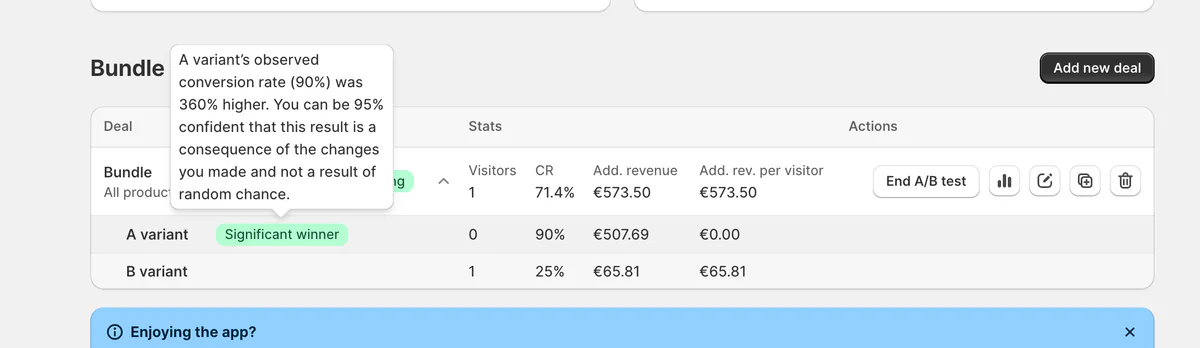
2. How a significant winner is calculated ✅
We determine the winner based on conversion rate (CR):
- Each test variant must have at least 10 orders to be considered.
- The difference between variants is calculated using a statistical significance formula, specifically a z-test, to determine whether one variant performs better than the other in a meaningful way.
3. Not enough data yet
If the test hasn't run long enough or hasn't collected enough samples, it may remain undecided.
4. High performance overall is still a win
Even if there' no "significant winner", the fact that both variants perform well is a positive outcome. It shows that your base idea works, and you can use either variant confidently.
5. Next steps you can take
- Let the test run longer to collect more data.
- Consider testing a more impactful change to increase the chance of a measurable difference.
- If both variants perform strongly, you may choose the one that best aligns with your brand or long-term goals.
Need help? Drop us a message in the live chat, and we'll sort it out together.